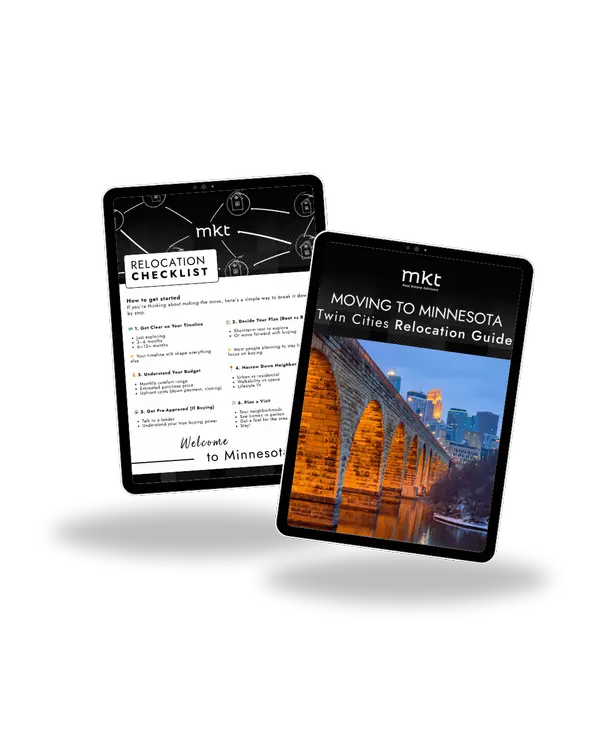

Why Moving to Minnesota Could Be the Best Decision You'll Ever Make

Why Moving to Minnesota Could Be the Best Decision You'll Ever Make
If you've only ever heard two things about Minnesota, they're probably "it's cold" and "everyone's really nice." Both are true, but neither one comes close to explaining why so many people who move here end up staying for good.
Moving to Minnesota means trading in traffic-choked highways or sky-high rent for something a lot of transplants don't expect: a place where you can actually afford a life, not just a lease. We're a real estate team based in Southwest Minneapolis, so we see this decision play out constantly, families and young professionals landing here from Chicago, Denver, Austin, the coasts, and within a year they're the ones telling their friends back home to make the move too. Here's what you're actually signing up for.
What It's Really Like to Live in Minnesota
Minnesota runs on four real seasons, not the two-and-a-half most of the country gets. Summers are genuinely gorgeous, long evenings, warm lake water, patios full into September. Falls are the kind of postcard color-change people drive hours to see elsewhere. Winter is its own thing, and we'll get to that honestly in a minute. Spring shows up late and everyone loses their minds over the first 60-degree day like it's a national holiday.
The "Minnesota Nice" reputation is real, but it's more nuanced than the stereotype. People here are warm and helpful in the everyday moments, holding doors, waving you into traffic, chatting at the coffee shop. Building close friendships takes a little longer, since a lot of Minnesotans have deep roots and existing friend groups from high school or college. Give it a year, get involved in something (a sports league, a volunteer group, a neighborhood event), and that changes fast.
Then there's the lake culture. With thousands of lakes across the state and a chain of them right inside Minneapolis, "let's meet at the lake" is just a normal Tuesday sentence here, not a special-occasion thing.
Cost of Living in Minnesota
This is usually the first question anyone asks, and it's good news. Minnesota's overall cost of living sits a few percentage points below the national average, and housing is where that advantage really shows up. Median rent across the state runs noticeably below the national median, and home prices, while they've climbed like everywhere, still buy you significantly more space and land than most coastal or Sun Belt metros.
Rough budgeting numbers to work with: a single person can typically live comfortably in Minnesota on somewhere in the $52,000 to $69,000 range annually, depending on the city, and a family of four usually needs somewhere around $105,000 to $130,000. Groceries, gas, and everyday utilities land close to the national average, nothing dramatic there. The one line item to actually plan for is winter heating, which runs higher than in milder climates, so factor that into your monthly budget rather than getting surprised by your first January bill.
Minneapolis vs. Statewide Costs
Minneapolis itself runs a bit higher than the state average, which makes sense since it's the economic and cultural core of the Twin Cities metro. Even so, it stays competitive with other major metro areas, and you get outsized value for it: a real downtown, a major airport, professional sports, a genuinely great restaurant and arts scene, all without the price tag of Chicago or Seattle. Move a little further out into the suburbs or greater Minnesota, and costs drop even more.
Housing Market Snapshot
The Twin Cities housing market has stayed relatively stable and approachable compared to a lot of the country, with median sale prices in the metro landing well under what you'd pay in most major coastal markets for a comparable home. Inventory has been tighter than buyers would like recently, which means new construction has become a genuinely practical option for people who want more control over their neighborhood and layout instead of competing for the same handful of resale listings.
What that budget actually buys varies a lot by area. A starter budget can land you a solid townhouse or smaller single-family home in the metro. A move-up budget opens up established neighborhoods with mature trees, character homes, and walkable amenities. And if you're aiming for something more custom or high-end, the metro has neighborhoods that deliver real luxury inventory without New York or LA pricing. If you want a closer look at what different budgets actually look like block by block, that's exactly the kind of local detail a neighborhood guide (or a quick conversation with an agent who works these areas daily) can save you months of guessing on.
Jobs and the Economy
Minnesota's economy is more diversified than people expect. The Twin Cities metro is home to a notable cluster of Fortune 500 headquarters spanning health care, finance, retail, and manufacturing, so the job market isn't leaning on one industry the way some cities do. Unemployment here has consistently held competitive with, and often better than, the national rate.
The honest tradeoff people bring up is state income tax. Minnesota's top bracket is among the highest in the country, which sounds worse than it plays out for most households. The top rate only kicks in at a high income threshold, and most working families end up paying an effective state rate well below that headline number. Weigh it against lower housing costs and lower overall cost of living, and the math tends to work out favorably for most mid-career professionals moving here, especially compared to high-tax, high-cost coastal cities.
Winters: What to Actually Expect (and How to Prepare)
Let's not dance around it. Minnesota winters are long, genuinely cold, and they show up whether you're ready or not. January averages hover in the high teens, snowfall adds up over the season, and there will be a handful of days that make you question your life choices. That's the honest version, and you deserve the honest version before you sign a lease.
Here's the other half of the story: Minnesotans don't just survive winter, they've built an entire culture around enjoying it. Ice skating rinks pop up in nearly every neighborhood park. Sauna culture has exploded across the Twin Cities. Patio heaters and fire pits keep outdoor hangouts going well past the point other cities would call it quits. Cross-country skiing, ice fishing, and pond hockey are just normal weekend plans for a lot of people.
Practical prep matters more here than almost anywhere else you'll move from. Get real winter tires, not just all-seasons. Have your furnace and windows checked before the first cold snap. Invest in a genuinely warm coat and boots rather than layering up cheap gear, you'll wear them every day for months and it's worth doing right. Do this and winter goes from something you dread to something you plan around.
Things to Know Before Moving to Minnesota
A few practical items that don't always make the tourism-board version of this list:
- Minnesota Nice takes time. People are friendly immediately and close friends eventually. Join something local and that timeline shrinks fast.
- Property taxes vary a lot by city and county. Worth researching specific to the neighborhood you're targeting, not just the state average.
- You've got a window to get your driver's license and vehicle registration updated after you establish residency, so put that on your calendar early.
- School district matters more here than in a lot of states. Districts can vary meaningfully block to block, so research this before you fall in love with a house.
- "Going up north" is a whole lifestyle. Cabin culture on the state's lakes is a huge part of how Minnesotans spend their summers, and it's worth understanding even if you're not buying a cabin yourself.
- The State Fair is not optional. It's one of the largest in the country and genuinely a Minnesota rite of passage.
- Farmers markets and seasonal festivals run heavy from May through October, which is part of why locals pack so much into the warm months.
Moving to Minnesota from a Specific State
From California: the headline is housing relief. Your money goes noticeably further here, whether you're renting or buying. The honest tradeoff is Minnesota's state income tax, which runs higher than California's for some brackets depending on income, plus a real winter adjustment if you've never lived through one. Most transplants tell us the overall cost-of-living savings still comes out ahead.
From Texas: similar story on housing, your budget will stretch further in Minnesota than in most Texas metros right now. The tradeoff to be upfront about is that Texas has no state income tax, so that's a real number to run before you move. Weigh it against Minnesota's lower overall cost of living, strong schools, and healthcare systems, and for a lot of families it still pencils out.
Moving to Minneapolis, Minnesota
If you're landing in the metro specifically, a little geography helps. Minneapolis and St. Paul are two distinct downtowns (the actual "Twin Cities"), each with its own personality, surrounded by a ring of suburbs that range from dense and walkable to spacious and quiet.
Within Minneapolis itself, neighborhoods vary a ton. Southwest Minneapolis, including areas like Tangletown, offers tree-lined streets, character homes, and a genuinely community-feel pace of life while still being minutes from downtown. Loring Park sits right at the edge of downtown with a walkable, social energy and easy access to the city's nightlife and events. Uptown blends shopping, restaurants, and lake access into one of the more energetic pockets of the city. Every neighborhood has its own rhythm, and figuring out which one actually fits your lifestyle (not just your budget) makes a bigger difference than most people expect going in.
Commute times and lake access are worth weighing heavily here too. Minneapolis is built around its lakes in a way few American cities are, so proximity to a lake, a bike trail, or a specific school district can matter as much as square footage when you're picking a neighborhood. This is exactly the kind of decision that's a lot easier with a local agent in your corner, someone who can match your day-to-day life to the right pocket of the city instead of you guessing from listing photos.
Are People Actually Moving to Minnesota?
Yes, and the reasons are consistent across the people we talk to. Affordability relative to coastal and Sun Belt cities is the biggest driver, especially for buyers who've been priced out of homeownership elsewhere. A diversified job market and strong healthcare and education systems round out the practical case. And once people get here, quality of life, the lakes, the outdoor culture, the sense of community, tends to be what actually keeps them.
Your Minnesota Moving Checklist
- Research neighborhoods and school districts before you commit to a location
- Connect with a local real estate agent who knows the specific area you're targeting
- Get pre-approved if you're buying, so you can move fast in a competitive listing
- Budget for moving costs and first-month expenses, including a security deposit or closing costs
- Plan your DMV visit for your driver's license and vehicle registration
- Set up utilities ahead of your move-in date
- Winterize: real winter tires, a home heating check, and a proper cold-weather wardrobe
- Register to vote and find a new healthcare provider
Making the Move
Moving to Minnesota is a bigger adjustment than moving somewhere with the same weather and price tag you're used to, but for most people who make the leap, it's the trade they'd make again in a heartbeat. Affordable housing, a stable job market, four real seasons, and a genuine sense of community add up to a quality of life that's hard to find in most of the country right now.
If you're weighing a move to the Twin Cities and want a real answer on what your budget actually buys in a specific neighborhood, that's exactly what we're here for. Reach out to our team and we'll walk you through it, no pressure, just honest local guidance from people who actually live here.
Categories
Recent Posts



THINKING ABOUT MOVING TO MINNESOTA?
Get our free guide covering cost of living, neighborhoods, and everything else you need to know before making the move.